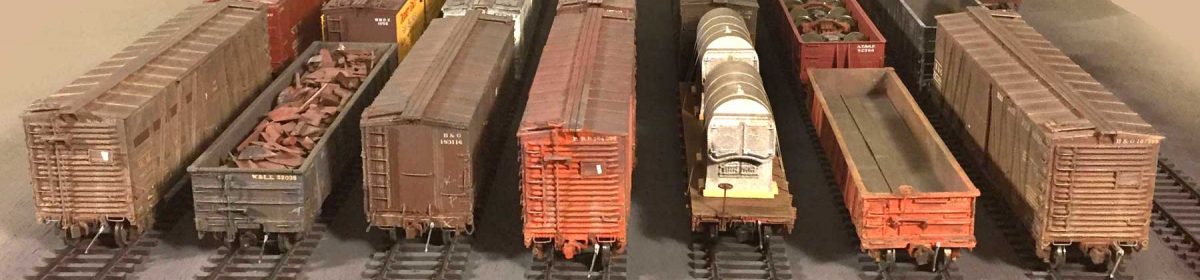
Many modelers focus on a specific point in time to guide their layout efforts. There are a number of markers that can be used to pinpoint the time an image was taken. Many railroads introduced emblems or new lettering at different points in time on their rolling stock. Steve Hedlund sent along details about Missouri-Kansas-Texas box car lettering practices that I found interesting so this blog post is mainly Steve’s. I added a couple points at the end and I’m certain this type of info will be revisited. For now, enjoy Steve’s work.
Tag: freight cars
New Haven steel coal gondolas
Fellow Pre-Depression Era modeler Dave Parker has sent notes on a recent resin freight car kit build. Click on any image here to review a larger size. Here’s Dave’s story.
In 1929, the New York, New Haven and Hartford received 500 class GA-2 gondolas from the Pressed Steel Car Company. These all-steel, drop-bottom gons had an inside length of 40 feet, and were numbered in the 58000-58499 series. Based on my collection of Official Registers, 496 remained in service as of 1945, but by 1955 this number had dwindled to 276 cars, and all had been rebuilt as solid-floor cars (GB classification). At some intermediate date, probably about 1950, the 58000 series apparently contained a mix of original and rebuilt cars, but I do not own an ORER that gives the exact numbers.
Prototype Data Files – pt 1

As announced here a couple of months ago, Accurail is working on an HO scale 36-foot box car model. They are planning four variations and have announced the initial paint and lettering schemes. Ray Breyer has pulled together prototype photos and details for each of the introductory models that will have fishbelly center sills and steel ends. He has created a very nice resource that can help modelers understand the similarities between the model and prototype. The initial PDF data sheet is posted on a special blog page, Accurail Prototype Data.
About my freight car fleet

I received an email from a regular blog visitor at the end of 2015 that posed some very interesting questions. Here’s the message.
“Many of your recent posts describe prototypes built no more than fifteen years prior to your 1926 modeling period.
Do you know of – or have a feel for – the average age of the freight car fleet at that time? It seems to me that the great majority of the prototypes you have modeled so far represent relatively new cars. I know there was a lot of rolling stock construction going on around the end of the First World War and through the nineteen-twenties, but how much of this replaced older cars, rather than augmenting them and growing the overall fleet size?
I also am aware that car (and train) weights were increasing at that time so the very oldest cars may no longer have been man enough to run with the new construction, but presumably you need some cars built prior to 1910 or so to maintain a representative total fleet?”
There are some good questions here for anyone modeling the 1920s or a specific era. Let’s take a look at each question and some data and opinion.
Holiday Lull

I returned to my workbench the other day and unearthed a project I started over a month ago. I seem to experience a holiday lull in hobby activity each year as outside activities increase and a family member or two travels to this tip of far west Texas for a visit. Old Man Winter played a trick and dumped eight inches of snow on the region to shut things down for a couple of days. I also dealt with a wonderful blog software update here that had gone awry. It was very good to sit at the workbench again and make progress.

