Time Marches On

March 10th, 2010

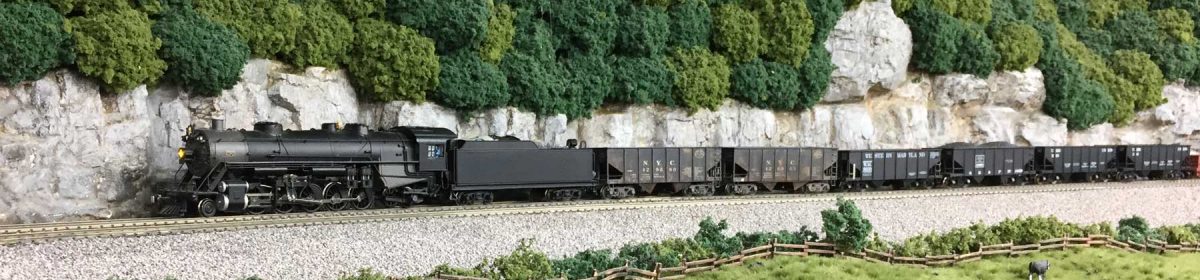
With the impending arrival of warmer weather, I notice my schedule has several interesting events. Before getting to that, here’s a recap on recent modeling and design difficulties and progress.

Read the rest of this entry »

February Update

February 12th, 2010

Erie 1932 ARA box car. 

It seems I’ve been keeping busy with lots of little projects since the last post. One of those “little” projects actually turned into a large project and occupied a good chunk of time.

I’ve been the webmaster for a model railroad club in Morgantown, W. Va., and a member since the group formed back in 1987. The members have been building a large HO scale model railroad since the early 1990s. Over the last couple of years, I’ve been trying to create a web page tour of the model railroad but I really didn’t have enough quality images to do this well. This project has been on my mind more since moving away from Morgantown early in 2009. It’s not an easy task to convey a model railroad with 500 feet of mainline into a few web pages and images. Lots of pondering and idea scribbling happened on paper before the computer was even turned on.

I visited Morgantown at the very end of December 2009 and spent a day just taking images along the mainline to capture the flavor of the railroad at this point in time. A tripod was used to steady my Nikon D60 and the white balance settings for the camera were adjusted for the layout room. All focus was done manually and a timer was used on the shutter release. Several images were taken at each location using various exposure times at the smallest aperture opening of the camera lens. After getting back to the Ohio home, the images were reviewed and several were chosen for web use. These were adjusted, enhanced, cropped and sized using Photoshop for use on the web pages. Descriptive text was written then new web pages were created for each location. A couple of new graphics were developed to assist with the tour and everything was carefully compiled into the HTML code. The project wrapped up about a week ago. A model railroad is ever evolving, but at least this layout tour captures the efforts of one club in the middle of a long journey.

Between the web work tasks, I’ve also been sorting out the freight car fleet to see what fits and what does not. We accumulate hobby stuff like wild animals. I’ve pulled several items and upgraded some to encourage an easier sell at the spring train shows. Along the way I spruced up a recent purchase and documented some weathering techniques. You can find out more at this Model-Railroad-Hobbyist blog entry.

There has been some progress on the home layout. A few more 1926 era freight cars are being constructed and I have a better understanding of the Wheeling & Lake Erie freight car fleet of that time. I may elaborate more on that soon.

And no, I still have not sanded the layout room floor.

A Free-Mo Experience

December 16th, 2009

part of the layout 

On November 6th, I journeyed to Syracuse, NY, to participate in a Free-Mo meet at the Great New York State Model Train Fair. About twenty participating model railroaders came from central New York and from as far away as Boston, MA, and Akron, OH. Most of the participants brought one or more Free-Mo modules to assemble into a linear model railroad. Click here for a PDF of the overall plan.

Modular display layouts have become common fixtures at large train shows. Many of these layouts are composed of modules that are built to published standards to ease assembly into the large display. The N-Trak standards were one of the earliest accepted design standards I can recall. The National Model Railroad Association (NMRA) modified these for use in other scales and variations of these standards continue to be followed. A typical presentation features a multi-track mainline running through individual scenes in a large circle. The Free-Mo standards enable a single track railroad display using Digital Command Control (DCC) to move trains along the route. At this time, I feel the Free-Mo standards set a level for a display layout that enables use of the most current model train control ideas and technology.

Read the rest of this entry »

Stalled

November 19th, 2009

 On the trail with the dogs.

The seasons have turned from summer to autumn, and winter is arriving soon. All around my region projects are being completed. Familiar orange and white highway barrels are disappearing and the last harvests are being gathered. Meanwhile, my home layout project has stalled. The layout room floor remains untouched and in need of sanding and finishing. Someday soon this task will be completed and I can begin erecting the layout benchwork. For the want of a nail…

Other projects are moving forward even as the layout has not progressed. I’ve turned to my large stash of freight car kits and started building a few. Several are now ready for the paint shop. So to make this a more interesting read, I offer a progress report from the car shop foreman.

Read the rest of this entry »

Choosing a Specific Era Assists the Modeling

August 31st, 2009

Box cars of two different eras. 

A wide variety of locomotives and rolling stock are available in all scales through hobby shops, on-line vendors, and train shows. Choosing to model a specific prototype railroad can reduce the modeling choices for these items. Setting a specific modeling era or period can further refine the modeling efforts and keep purchasing focused.

Taking this step requires a dedication to understanding the prototype railroad world of the chosen period and to make an effort to stay with the plan. Choosing a specific year can mean sacrificing the use of popular locomotives or paint and lettering styles. As an example, if 1948 or 1949 is chosen as the modeling period, then ALCo RS-3 locomotives cannot be used as they entered into service in 1950. A similar situation arises for those who model the WM of 1951 or 1952. Home road rolling stock would only have the Fast Freight emblem and locos should only have the Fireball emblem. The notable Speedletter painting and lettering style, as seen above, would become the WM standard in 1954. Understanding data points like this can assist in making choices in following a specific modeling year. Read the rest of this entry »

Additional Resources

July 21st, 2009

An offshoot of model railroading that has given me much enjoyment is researching different aspects of the prototype. As you can see in the previous post, I get a little excited when some historical details combine to offer an interesting modeling opportunity. What I failed to note at that time are a few related resources that many people may have considered earlier in the game. I had actually consulted a few of these resources, but forgot to note them.

W&LE book covers

John B. Corns has published two books on the Wheeling & Lake Erie Railway. These volumes offer fine historical overviews of Ohio’s Iron Cross line. Motive power, depots and facilities, and rolling stock are featured. Combined, both books offer a significant understanding of the W&LE and ar recommended. Titles are simply The Wheeling & Lake Erie Railway (copyright 1991 by TLC Publishing, Inc.), and The Wheeling & Lake Erie Railway Volume 2 (copyright 2002 by TLC Publishing, Inc.). Only two images of the East 93rd Street Yard area are featured, but the locomotive details and freight car images are very useful.
Read the rest of this entry »

Finding a Prototype Inspiration

July 2nd, 2009

1934 Cleveland rail map. 

It didn’t take long to realize the region around Cleveland, Ohio was crazy with railroad lines. The above image is just a portion of the picture. Here’s a larger version of this 1934 railroad map. At one time, Cleveland was an amazing hub of transportation and manufacturing. Make sure you click on the map when it opens in a new page as many browsers will show the enlarged image. Scrolling left and right, and up and down reveals dozens of yards and interchange points across the city. The busy Cuyahoga River valley was a teeming maze of steel rails from the docks at Lake Erie south about a mile. Six class one railroads converged on this industrial epicenter: New York Central, Erie, Pennsylvania, Nickel Plate, Baltimore & Ohio, and the Wheeling & Lake Erie. Four smaller railroads were also entwined among the industrial avenues and canyons. How can anyone find something bite-sized to model here?

Read the rest of this entry »

An Invite to Op!

June 25th, 2009

Locomotives ready for work.

As I’ve settled in at the new home, I’ve met some local model railroaders through a few email groups. A few weeks ago I received an email from Tim, a local model railroader. He invited me to operate on a local layout. After checking the family calendar, I sent a note that I was clear to attend.

If you have not had the opportunity to operate on a model railroad using rules and procedures of the prototype, I highly recommend you reach out for this experience. I attended an operating session in 1987 that was a defining moment in my hobby career. Operating a model railroad makes it come alive. The purpose of the tracks and design become more apparent with train movements and spotting freight cars at industries. From that moment on, my perspective on designing and building model railroads changed. 

Read the rest of this entry »

Formulating a Plan

June 12th, 2009

It’s like an old joke.

Q: What does a model railroader do with a spare room?

A: Fills it with trains!

And that is the plan, kind of. This spare bedroom is my model building space, so it needs to be organized to maximize the possibilities. In review, this space will contain a workbench, tools, storage for kits and building supplies, storage for resource books, and an HO scale model railroad.

Read the rest of this entry »

A Basement Review

June 3rd, 2009

I’ve received some feedback with an inquiry about the basement. I’ve mentioned it is not suitable for a model railroad space. Most of the new home dates to the mid-1800s. It was built as a farm house and has a stone foundation. Over the years, there have been additions and improvements. I suspect the basement floor was once dirt, but it is now an uneven concrete surface . Read the rest of this entry »